Just a small post here-
Over the past few months I've been noticing that the more I use carbolic soap, the less I like the scent of modern soaps/softeners/detergents. Now, those of you who have grown up with carbolic soap know the smell- the closest thing I can compare it to is the smell of burning tires. But that's all it is, perhaps with some sweeter undertones. I'm finding that modern soap smells grate on the back of my throat like a harsh chemical might. This is interesting to me because carbolic is a chemical (phenol) and it doesn't have that effect on me. What, then, does modern soap contain?
I decided to have a look.
Carbolic Soap:
Sodium palmate/palm kernelate, water, glycerine, cresylic acid, carbolic acid, sodium DTPA.
Irish Spring:
Soap (sodium tallowate and/or sodium palmate, sodium cocoate and/or sodium palm kernelate), water, glycerin, hydrocenated tallow acid, coconut acid, fragrance, sodium chloride, pentasodium pentetate, pentaerythrityl, tetra-di-t-butyl hydroxyhydrocinnamate, titanium dioxide, D&C Green No. 8, FD & C Green No. 3.
...I will never be able to pronounce "tetra-di-t-butyl hydroxyhydrocinnamate".
Now, I'm not crying from the rafters about "oh no harmful unnatural chemicals in soap!!!" because obviously carbolic isn't exactly all natural lye soap either. I'm not advocating you stop using modern soap- I'm sure that tetra-whatsits is in there for a reason and does its job splendidly. I just think it's curious how things have changed, and wonder how necessary all the extra stuff really is.
Saturday, September 26, 2015

Wednesday, September 16, 2015
For Days When The Icebox Triumphs Over The Range
Today in Sunny Southern California it's finally cooled down from the past few weeks. By "cooled down" I do of course mean that the thermometer is pushing a sweltering 86ºF- three blocks from the beach. I'm Irish. We've been known to turn to ash in weather like this. 'Tain't natural.
I woke up, as most mornings, with all the sincerity in the world to help myself to a cup of tea. I filled up the kettle, put it on the stove, and-
I couldn't do it. I couldn't let another lick of heat into this cruel, hot world.
Our stove is gas, but the majority of cooking throughout history has gone on either in a range (a solid-fuel burning stove) or a massive hearth fire. These fires also double as central heating, and on a day like today, I'm sure there would have been at least a few for whom it simply couldn't be borne.
But when breakfast is bacon and eggs, what's a gal to do? Resisting the urge to go get a shave ice (snow cones are period from the 1850s, with shavers being patented in the 1890s and commercial selling of at-home shavers beginning in 1919), I settled for a bowl of cold milk and some cereal.
When on earth do we get cereal, you ask. Well, I'll tell you.
The first dry cereal is commercially sold in 1863 as "Granula". It isn't that popular, as to be eaten it must be soaked overnight, at which point the consistency is somewhere between soggy cereal and porridge. Grits at this point are considered outside the southern United States to be food for horses- men eat meat in the morning!
In 1877, Ferdinand Schumacher, who had founded an oat products company in 1854, adopts the Quaker as his symbol. The cereal "movement" is considered one for health and, very often, morality.
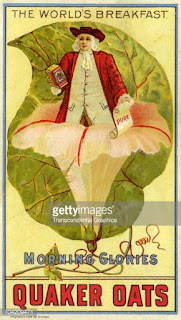


He adds sugar, and focuses on taste- his signature becomes the company trademark.


While Kellogg has always been a popular brand, there were the lesser-knowns, as well.
And, my personal favorite- advertising at its finest.

I woke up, as most mornings, with all the sincerity in the world to help myself to a cup of tea. I filled up the kettle, put it on the stove, and-
I couldn't do it. I couldn't let another lick of heat into this cruel, hot world.
Our stove is gas, but the majority of cooking throughout history has gone on either in a range (a solid-fuel burning stove) or a massive hearth fire. These fires also double as central heating, and on a day like today, I'm sure there would have been at least a few for whom it simply couldn't be borne.
But when breakfast is bacon and eggs, what's a gal to do? Resisting the urge to go get a shave ice (snow cones are period from the 1850s, with shavers being patented in the 1890s and commercial selling of at-home shavers beginning in 1919), I settled for a bowl of cold milk and some cereal.
When on earth do we get cereal, you ask. Well, I'll tell you.
The first dry cereal is commercially sold in 1863 as "Granula". It isn't that popular, as to be eaten it must be soaked overnight, at which point the consistency is somewhere between soggy cereal and porridge. Grits at this point are considered outside the southern United States to be food for horses- men eat meat in the morning!
In 1877, Ferdinand Schumacher, who had founded an oat products company in 1854, adopts the Quaker as his symbol. The cereal "movement" is considered one for health and, very often, morality.

Wheatena, invented by George H. Hoyt, is the first cereal sold in boxes. Previously it had been sold by weight from barrels by regular grocers.

The American Cereal Company is founded in 1888 from an amalgam of smaller companies.

John Harvey Kellogg patents in 1891 and launched in 1895 "cornflakes". Originally used as a health food by Kellogg at his Health Reform Institute, their blandness was believed to "discourage the passions which lead to autoeroticism".
In 1898, Charles Post, a patient of Kellogg's, introduces Grape Nuts as the breakout product for his own cereal company.


In 1900, Quaker Oats grosses $10 M in annual sales.
John Kellogg's brother William buys the rights to Cornflakes from his brother in 1906 and begins his own venture in the Kellogg Toasted Corn Flake Company.


He adds sugar, and focuses on taste- his signature becomes the company trademark.
Meanwhile, British brands like Force and Golfer are flourishing across the pond.


While Kellogg has always been a popular brand, there were the lesser-knowns, as well.


And, my personal favorite- advertising at its finest.

So next time it's hotter than the hobs, and it's just too hot for that fry-up, crack out the corn flakes and have a nice, cold, period breakfast!
Monday, September 14, 2015
The Unexpected Advantages of Victorian Cleanliness
I know what many of you must be thinking. "Didn't they like, only wash once a week though?"


Warning: If you have never smelled carbolic soap, do not expect that "added scent" they add to try to cover up the smell to work even remotely well. When I order mine, even the package smells as if someone had posted me a burning tire. This stuff is made of coal tar, and it very much smells like it. That said, generations of using the soap has led to the scent being associated with cleanliness. While that may be changing with a generation whose parents weren't raised with carbolic, just ask someone who grew up with it and they will agree!


No. No they did not. There is in fact no period within our timeline when people did not clean themselves almost daily in some way or another. There have absolutely been periods when the medical establishment advised against bathing (for our purposes, 'washing with water'), but people have generally found effective ways to keep clean, and the Victorian period was probably one of the biggest periods for emphasizing cleanliness, even to the point of what many modern people would see as paranoia.
The 19th century in particular introduced a great number of innovations that led to the explosion of hygienic practices in the public consciousness.
First was the rise in the commercialization of the chemist. The 19th century saw "medicine" change from something you could only get from the doctor to something you could walk into a shop and purchase from a druggist. This had, of course, positive and negative effects (it is estimated that about a third of infants who died in the 19th c. did so because of starvation at the hands of opiates given to them by mothers who were trying to keep them from crying while they were at work), but it was certainly instrumental in making cleanliness accessible (and even affordable) to all levels of society.
Second was disease. Of course, earlier centuries had had disease and famine a-plenty, but with the rise of industrialism and crowded cities and tenements, large-scale epidemics became not only larger in scale but also much more common, almost seasonal. A few major public health incidents like the Soho cholera epidemic of 1854 (and two previous in 1831 and 1848) and the Great Stink of 1858 forced the hand of both government and science to find a solution to the problems of filth and disease that plagued cities.

Caricature from Punch, 1858, showing the diseases spread by the sewage in the Thames.
The former resulted in the discovery of the cause of cholera being contaminated water. Scientist John Snow (yeah) traced the outbreak back to a well on Broad Street that had been built too close to a cesspit and removed the handle to it. While he himself contended that the outbreak might have been on the decline anyways, he did prove that the water from the well was contaminated with cholera- the diapers of a diseased baby had been thrown in the cesspit, and the fecal matter had leaked through. Cesspits were traditionally underneath houses, but this one had been extended when the street was widened several years earlier, forcing the row of houses back. Many families hired special night workers to come collect extra refuse from cesspits that wasn't decomposing quickly enough and throw it in the Thames, which led to the latter event. This, combined with overcrowding that came from the increase of population in London from one to three million from 1800-1850, meant that many families who had previously had the luxury of keeping their cesspits at the end of a long back garden underneath an outhouse now were located basically on top of it. The Great Stink was the culmination of many years' complaints by Londoners, whose knowledge of the Thames' contamination was by no means new:

"Monster Soup commonly called Thames Water" by William Heath (1828)
The Great Stink of 1858 had been brewing (no pun intended) for several years. Prior to the acceptance of germ theory, the main accepted idea of disease proliferation at the time was the miasma theory, or the idea that disease was spread through the air via foul smells that resulted from effluent or the breath of a diseased person, etc. This was not entirely wrong- it was in essence the idea of airborne disease, and those of you who have had the opportunity to smell disease know exactly why this would be a prevalent idea. In 1855, scientist Michael Faraday had done an "opacity test" by dropping pieces of white paper and seeing how far down they could go and still be seen. His conclusion was, in short, that the Thames was no better than any street sewer.

A caricature of Michael Faraday's paper opacity test, Punch, 1855.
The increasing stench of the Thames led the government to pour a mixture of chalk lime, lime chloride, and carbolic acid into the river in 1857. There are many ways to skin a cat, and regardless of what theory you ascribed to, carbolic acid is a very good way to kill Choleric Creepy Crawlies (TM). The smell, however, became so strong in the sweltering summer of 1858 (temperatures reached 118ºF in the sun) that the stench became overpowering for almost all of London, to the point where Parliament had the river-facing curtains covered in lime chloride to hide the smell.

"How Dirty Old Father Thames was whitewashed", depicting the pouring of lime into the Thames, Punch, 1858.
The stench, now so awful that it was noticeable even to higher class families and officials, prompted the acceptance of a scheme by authorities proposed by civil engineer Joseph Bagalzette for a new sewer system that took refuse not to the Thames, but beyond the city into treatment plants. The system was began in 1859, lasted until 1875, and is still in use today. There was never another cholera outbreak in London.
Why did this take so long? As with many things, not much pressure was put on the government until the problem was effecting higher society. People expected the Great Unwashed to be dirty and diseased, regardless of the cause. The very fact that we have the contemporary term "the great unwashed" to refer to the poor in Victorian society, however, tells us how much of a 'must' washing WAS to them. To the Victorians, cleanliness was quite literally next to godliness, and part of the rationale behind the widespread criminalization of poverty was the idea that those who were unclean were morally unfit. This was due in great part to new innovations in medical science which replaced the miasma theory with germ theory. Which is where things get interesting.
You will hear people say how long it took for people to accept germ theory. And if you're talking about the fact that the theory itself has was thrown around as early as 1546, then I'll play ball. But the 19th century proliferation of it catches on a lot faster than I think people give it credit for. In 1850, Dr. Ignaz Semmelweis found that when he and his colleagues washed their hands in lime chloride, the rate of puerperal fever in their patients reduced dramatically. You will hear that Dr. Semmelweis had a hard time convincing the scientific community to wash their hands, but people were only too happy to do so when Florence Nightingale implemented the practice in Crimean hospitals only four years later. Louis Pasteur conducted his airtight food experiment (proving that food not exposed to air would not rot) in the early 1860s, carbolic acid was used to sterilize operating theatres and wounds in 1865, and bacteria was officially assigned to different diseases by Robert Koch in 1879. I've seen history textbooks say that germ theory wasn't accepted until the late 1890s, and I think that's ridiculous. Here's why-
Germ theory, to quote social historian Ruth Goodman, "changed everything and nothing". Hygiene practices under miasma theory dictated cleaning the same things that germ theory did- a body that did not smell was a body that was washed, you still had to keep cesspits clean, you still had to keep a sick person's room immaculate. However- and here we reach our point- you didn't just have to keep things clean to the point of not smelling bad, you had to keep them clean to the point of smelling sterile. If germs were everywhere, you couldn't just wash them away, you had to kill them. The Victorians took this to heart and ran with it full force, and I don't think it took them half as long as the 1890s. The main instrument of the Victorian hygienic sword was carbolic soap. Made from the phenol out of coal tar, carbolic acid could kill bacteria and was sold in the form of soap. I have seen advertisements for carbolic soap as early as the 1850s, and advice pamphlets for ladies hiring domestic help in the 1860s advise that a good, reliable, clean maid should have the smell of carbolic soap about her person from regular washing. I don't think this is any surprise- in a world so prone to disease, I think even if I'd thought germ theory was bunk, I'd have covered all my bases in any attempt to reduce my risk of a horrible, vomit-and-diarrhea-induced death. These people weren't fools, and if all it took was a bar of carbolic to take preventative measures, I'd have been all in.
Yes yes, enough with the pontification and the history lesson- what about the process?
Materials
First, you need a washstand. This is almost exactly the same to the one I have (part of which you can see in my picture of the lavender water I made) :

Most washstands have at least room for a bowl- most have a place beneath or next to the bowl for a pitcher, and some even have a mirror. Like this one, mine also has room for two towels on either side and two candle holders. The mirror is adjustable and can be moved back and forth to adjust to the height of the person using it. You can't see it, but behind the washbowl and under the mirror there's a small crescent-shaped platform for holding soaps, etc.
You will also need an additional bucket for when you change water. For the washbowl and pitcher, you can use porcelain if you have it- enamel is also period and would have been a more economical choice. You will also need a towel of some variety- I tend to like to use two, one for the main wash and one for areas with more dirt or sweat (underarms, groin, etc.).
Most Victorian manuals advise using rainwater instead of hard water when it can be got, but I live in Southern California and it can hardly ever be got so readily as it might be in England! When I can, I do like to use rosemary water- as a slight astringent, this works well to remove oils. Pour boiling water over rosemary into your bowl; when it cools, strain the rosemary and use. This works well for hair, as well.
A Brief Discussion on Soaps
The Victorians had several soaps for several purposes. Soap with which to launder clothing was usually some kind of lye soap- soap for washing the personage could contain lye, and often contained rosemary or lavender, too. Lavender soap, water, oil, and tussie mussies were all enormously popular.
Carbolic soap was generally used for disinfecting or getting something quite clean, but it was advertised for being able to clean houses, breakouts on the skin, and even (in one advertisement) dogs. Most Victorians at one point, even if just for spring cleaning, went over everything with carbolic. Even those individuals who grew up before the 1970s should remember carbolic soap being used, even if just in school (having your mouth washed out with soap is considerably more unpleasant with carbolic than Dove- kids don't know how good they have it these days!). While often bleached, the phenol in carbolic soap renders it a bright red color. Carbolic soap today can be difficult to find in a pure form- even the oldest manufacturers of "coal tar soap" now only make their soap with the scent of carbolic acid, not the actual product. This is because carbolic soap can be quite harsh on the hands if used very often, so be sure if you use it to rinse your hands very thoroughly. You can buy real carbolic soap containing carbolic acid here.

Warning: If you have never smelled carbolic soap, do not expect that "added scent" they add to try to cover up the smell to work even remotely well. When I order mine, even the package smells as if someone had posted me a burning tire. This stuff is made of coal tar, and it very much smells like it. That said, generations of using the soap has led to the scent being associated with cleanliness. While that may be changing with a generation whose parents weren't raised with carbolic, just ask someone who grew up with it and they will agree!
Procedure
First, you fill up the bowl with some water from the pitcher. This water should be boiling- Victorian soap will not dissolve in cold water. If you have rosemary in the bowl, you'll need the hot water over it- if you're using soap, you need to either shave some into the bowl, or shave some onto the towel and lather it in while the water is still hot.
Attend to other activities like brushing your hair, etc. Victorian advice prompted the brushing of hair to redistribute oils lost in washing, so one combed out tangles and then brushed hair with bristle brushes. This is remarkably effective, and throughout the 16th-18th c. was almost entirely the method of keeping hair clean, combined with powder that acts like dry shampoo. By the 1840s, it was advisable that the hair be washed once a week, with any more being considered too harsh for the scalp. This was certainly true then with more caustic soaps- it remains true today if for no other reason than skin that is washed of oils very often will overproduce them to compensate. You can also brush your teeth- various tooth powders were available at the time. Just dip your brush into the pitcher, dab it in tooth powder, brush, and spit into your bucket.

Once the water has cooled (if it's early or cold, you might want it warmer- it's been very hot here recently so I use the fact that I have very thick hair to let the water get quite cool), take your towel and wash your entirety thoroughly. By the time you are done, the water will be quite dirty. Pour it from the bowl into your dirty water bucket. Refill your bowl with the rest of the water from your pitcher- use the clean water to rinse yourself off with the towel. I find that getting the remnants of the soap out of the towel is easiest if you put the towel in the bowl and pour the rinse water over it. There probably won't be much left on it anyways, and if there is this gives you the opportunity to change the bowl again before getting a clean bowl of rinse water.
There are a few additional advantages to this process that go beyond just cleanliness, though!
I'll be the first to admit it- I hate showers. I like being in the shower- I'm that special brand of time waster that spends nothing short of 45 minutes in there. And I love feeing clean after the shower. But I hate being cold and wet when I get out, I hate having water fall down on me and the subsequent juggling act I have to perform with the hose to avoid it, I hate adding to the water bill, I hate getting the obnoxious shout of "you know there's a drought!!!" fifteen minutes into said shower, and I hate getting into a hot shower on a hot day (but of course you can't take a COLD shower because then you're freezing). Baths would be an impractical replacement, but I've found that Victorian washing is actually ideal.
It takes all of ten minutes, tops. It can be nice and warm but because the water isn't falling around you there's nothing to compel you to sit there and enjoy that for hours. You're not soaking wet so you're never too cold, and most Victorians bathed in the morning with their nightclothes on in any case, going bit by bit and still staying warm. I find I'm actually much more thorough when I wash this way- you don't have the torrent of water giving you a false sense of cleanliness, so you really have to scrub. The best part is though that I can empty the dirty water out into the garden, and all told, it uses maybe five gallons of water at the very most. Even if you live in an area that gets plenty of rainfall, your water bill won't scorn you for it!

Saturday, August 29, 2015
A History of Penmanship
Penmanship has existed in one form or another for thousands of years, so forgive me if this is a very brief overview! Do note that this, like the project, is focusing very specifically on Western Europe and the United States.
While people who could write have been writing since about the invention of writing (for our purposes, we have extant letters of everyday people from the very beginning of our timeline), handwriting did not become an "accomplishment" as such until the late 17th century with the standardization of non-Gothic fonts for copperplate engraving. Before that, it was mostly for professional document calligraphers who created the illuminated Gothic scripts with which most of us are familiar.


While penmanship as a profession was mainly male until a few exceptions, mainly in 19th and 20th century America, and handwriting was not taught in schools until the late 19th/early 20th century, penmanship as a skill was taught at home to every lady worth her salt from the very beginning of copybooks circulating in England. Ladies were expected to keep diaries, keep up correspondence, and often make their own calling cards. In a period when letters were treated almost like currency (ladies would often, upon receipt of a letter, read it, black out personal or intimate parts, and trade them with acquaintances for news as we might use magazines), your handwriting was just as much a statement of your character as what you wore. Because of this, handwriting was a part of every well-bred child's education from a very young age.

I had the pleasure to be given a couple reproduction penmanship manuals when I was at Victorian ladies' finishing school four years ago, and manuals like these abounded, not just to do with what to write in letters, but how to write:


While people who could write have been writing since about the invention of writing (for our purposes, we have extant letters of everyday people from the very beginning of our timeline), handwriting did not become an "accomplishment" as such until the late 17th century with the standardization of non-Gothic fonts for copperplate engraving. Before that, it was mostly for professional document calligraphers who created the illuminated Gothic scripts with which most of us are familiar.

Psalter in Gothic calligraphy and illumination, c. 1400-1424.

One of the Paston Letters, c. 1467, displaying the typical handwriting style of the period. While calligraphy remained Gothic in style, this was the script used for most everyday (and later, even most formal) documents until the widespread influence of the invention of copperplate engraving.
While penmanship as a profession was mainly male until a few exceptions, mainly in 19th and 20th century America, and handwriting was not taught in schools until the late 19th/early 20th century, penmanship as a skill was taught at home to every lady worth her salt from the very beginning of copybooks circulating in England. Ladies were expected to keep diaries, keep up correspondence, and often make their own calling cards. In a period when letters were treated almost like currency (ladies would often, upon receipt of a letter, read it, black out personal or intimate parts, and trade them with acquaintances for news as we might use magazines), your handwriting was just as much a statement of your character as what you wore. Because of this, handwriting was a part of every well-bred child's education from a very young age.

Sign written by an eight year old child, c. 1840.
I had the pleasure to be given a couple reproduction penmanship manuals when I was at Victorian ladies' finishing school four years ago, and manuals like these abounded, not just to do with what to write in letters, but how to write:

Very generally speaking, 18th century handwriting styles are called round-hand or Copperplate, and from the about the second quarter of the 19th century handwriting becomes what is known as the Spencerian style, which leads into Ornamental Handwriting.

IAMPETH (the International Associatio of Master Penmen, Engrossers, and Teachers of Handwriting) has an excellent video presented by Dr. Joseph Vitolo on the "Golden Age" of Handwriting, which will be my main focus with this project. This focuses on American handwriting, but round-hand is brought to the States from England, and Spencerian doesn't take very long to go the other way.
Enjoy!
Making Lavender Water
Leave it to me to make the first project ambiguously labeled!
I am going to try to post at least once a week, and since this week has involved attending a plethora of meetings, I haven't had time to do anything extensive. But, every little bit counts, so first a bit about lavender water and why it matters to the Project.
Lavender water is, for all intents and purposes, timeless. The ancient Romans (apparently- if I have any ancient world historians in the audience, please do correct me!) used to use lavender in their baths, and the oldest actual receipts (recipes) for and references to lavender water I have seen date to the mid-14th century; I'm sure the practice of using it is probably much older. Throughout the 18th and 19th centuries, its supremacy was intermittently usurped by more citrus-based scents like Eau de Cologne (originally its own scent, which I'll address in another post) and Florida Water, but it still remained popular enough to be mentioned in ladies' magazines throughout the period, and enjoyed a massive comeback in the late 19th and early 20th century.
I've seen a number of uses listed for lavender water, some of them more surprising than others. One thing is certain though- no lady's toilette (or pantry) is complete without it!
Lavender water can and has been used for:
-Perfume.
-Face/body wash.
-Freshening linens.
-Cleaning (usually recommended to be put into vinegar solutions to combat the smell).
-Mouthwash
-Flavoring.*
-Sunburn relief.
-Bug repellent (this really works).
-Calming the nerves (lavender is described as "mildly narcotic", and will actually act as a relaxant if put in bathwater, rubbed into the temples, etc. Make sure to mix essential oils with something else like witch hazel if you put them in water or the oil will just float on top).
*When you see lavender water in recipes, ALWAYS make it of actual water infused with lavender and proof alcohol, NOT the kind made with essential oils and witch hazel. I don't recommend ingesting this as made with essential oil- while neither it not witch hazel seem to actually be harmful, especially in trace amounts, the scientific jury is split enough that I'd think twice about it. One drop of essential oil is the equivalent of about 50 plants, and you wouldn't drink 50 cups of any other herbal tea.
The three basics of lavender water are:
-Soaked lavender in water OR lavender essential oil.
-Water
-Some kind of dispersant to mix the water and oil. This is usually some kind of proof alcohol (vodka works) or witch hazel. Depending on what you want to use your water for, change the dispersant accordingly.
For my recipe I used:
-3 ounces distilled water (tap water will work fine if you can't get distilled).
-1 ounce witch hazel
-10 drops lavender essential oil.
Add all ingredients together and shake well.
(Note: 1 fl. oz= 1/8 cup)
I was filling up a glass jar I bought to hold the water, so I ended up multiplying the whole recipe by ten. I decided to use oil and witch hazel because I'm not going to be ingesting this. Witch hazel is wonderful for the skin, and is sure to lend itself to the task if you intend to use the water for any skin-related purposes.
I also (as you can see below) ended up dyeing the water slightly purple with blue and red food dye, one drop of each- I wanted it to be more blue so I put in a drop of blue in a glass and then dabbed the red on my finger, which I used to stir the colors together in the glass. When I got the color I wanted, I dumped the glass into the bottle. Original lavender water was rarely actually purple, and making it so was an innovation introduced to give products in glass bottles some appeal. It is in such trace amounts in my bottle that it will not actually show up on the skin, though many Victorian skin creams were in that color range because of their ingredients, though I have found that it is also a color which, when blended, makes the wearer look more pale. While I am fairly pale (though perhaps not so much as I should wish), I am a very yellow-white, and those creams help me to look a more desirable blue-white. But I digress!
You can buy all of the ingredients at CVS or Walgreens, etc. if you don't want to order them- just check their in-store availability on their sites first. I ended up making this because I didn't want to buy it, which is funny, because my overall cost ended up being $8 over what I would have payed to just add it to my order. It all worked out though, because I ended up getting an even nicer bottle and label than what I could have bought. I got a glass bottle with a cork stopper at the Goodwill (this blog's tagline should be "how to achieve aristocracy on a budget"), and found an extant lavender water label online. Printed and glued on a couple minutes later and voila- lavender water! I will be using this mostly for perfume, washing, scenting linens and cleaning around the house.

I am going to try to post at least once a week, and since this week has involved attending a plethora of meetings, I haven't had time to do anything extensive. But, every little bit counts, so first a bit about lavender water and why it matters to the Project.
Lavender water is, for all intents and purposes, timeless. The ancient Romans (apparently- if I have any ancient world historians in the audience, please do correct me!) used to use lavender in their baths, and the oldest actual receipts (recipes) for and references to lavender water I have seen date to the mid-14th century; I'm sure the practice of using it is probably much older. Throughout the 18th and 19th centuries, its supremacy was intermittently usurped by more citrus-based scents like Eau de Cologne (originally its own scent, which I'll address in another post) and Florida Water, but it still remained popular enough to be mentioned in ladies' magazines throughout the period, and enjoyed a massive comeback in the late 19th and early 20th century.
I've seen a number of uses listed for lavender water, some of them more surprising than others. One thing is certain though- no lady's toilette (or pantry) is complete without it!
Lavender water can and has been used for:
-Perfume.
-Face/body wash.
-Freshening linens.
-Cleaning (usually recommended to be put into vinegar solutions to combat the smell).
-Mouthwash
-Flavoring.*
-Sunburn relief.
-Bug repellent (this really works).
-Calming the nerves (lavender is described as "mildly narcotic", and will actually act as a relaxant if put in bathwater, rubbed into the temples, etc. Make sure to mix essential oils with something else like witch hazel if you put them in water or the oil will just float on top).
*When you see lavender water in recipes, ALWAYS make it of actual water infused with lavender and proof alcohol, NOT the kind made with essential oils and witch hazel. I don't recommend ingesting this as made with essential oil- while neither it not witch hazel seem to actually be harmful, especially in trace amounts, the scientific jury is split enough that I'd think twice about it. One drop of essential oil is the equivalent of about 50 plants, and you wouldn't drink 50 cups of any other herbal tea.
The three basics of lavender water are:
-Soaked lavender in water OR lavender essential oil.
-Water
-Some kind of dispersant to mix the water and oil. This is usually some kind of proof alcohol (vodka works) or witch hazel. Depending on what you want to use your water for, change the dispersant accordingly.
For my recipe I used:
-3 ounces distilled water (tap water will work fine if you can't get distilled).
-1 ounce witch hazel
-10 drops lavender essential oil.
Add all ingredients together and shake well.
(Note: 1 fl. oz= 1/8 cup)
I was filling up a glass jar I bought to hold the water, so I ended up multiplying the whole recipe by ten. I decided to use oil and witch hazel because I'm not going to be ingesting this. Witch hazel is wonderful for the skin, and is sure to lend itself to the task if you intend to use the water for any skin-related purposes.
I also (as you can see below) ended up dyeing the water slightly purple with blue and red food dye, one drop of each- I wanted it to be more blue so I put in a drop of blue in a glass and then dabbed the red on my finger, which I used to stir the colors together in the glass. When I got the color I wanted, I dumped the glass into the bottle. Original lavender water was rarely actually purple, and making it so was an innovation introduced to give products in glass bottles some appeal. It is in such trace amounts in my bottle that it will not actually show up on the skin, though many Victorian skin creams were in that color range because of their ingredients, though I have found that it is also a color which, when blended, makes the wearer look more pale. While I am fairly pale (though perhaps not so much as I should wish), I am a very yellow-white, and those creams help me to look a more desirable blue-white. But I digress!
You can buy all of the ingredients at CVS or Walgreens, etc. if you don't want to order them- just check their in-store availability on their sites first. I ended up making this because I didn't want to buy it, which is funny, because my overall cost ended up being $8 over what I would have payed to just add it to my order. It all worked out though, because I ended up getting an even nicer bottle and label than what I could have bought. I got a glass bottle with a cork stopper at the Goodwill (this blog's tagline should be "how to achieve aristocracy on a budget"), and found an extant lavender water label online. Printed and glued on a couple minutes later and voila- lavender water! I will be using this mostly for perfume, washing, scenting linens and cleaning around the house.

Friday, August 28, 2015
The Usual Suspects...
I have those accomplishments in mind that I have found, and I should greatly like your help in both adding to the list and establishing tangible benchmarks of proficiency that I might work towards.
So, without further delay, I present The List. Keep in mind that we are spanning approximately 800 years, so things that might not occur to you as being "ladylike" in one period may be from another entirely! I will elaborate on the "heyday" of different accomplishments when I post about them. This is a very messy list- my comments are included where I need your advice, otherwise feel free to fill in the blanks- so I promise to be adding a cleaner-looking one to the post explaining the Project.
Accomplishment:
Horsemanship (Side Saddle)
Goal:
Being able to jump aside? Is that too overzealous? I do have a good deal of experience riding astride, but I have also had the opportunity to ride aside, and they are admittedly two different creatures entirely.

Accomplishment:
Sewing
Goal:
Those of you who know me know that I already have a great deal of experience sewing historical clothing. What do we think of... one complete set of clothing per rotation of fashion with period-correct construction for each? That could get to be a lot, especially come the 19th century. Might be interesting to chronicle, though, and it would give me an excuse to have something available for every time period I could wish to do. What do you all think?
Accomplishment:
Lace Making (Reticella, Punto in Aria, Knotting, Tatting, Tambour, and Broderie Anglaise)
I've chosen so many- and these in particular- because they span both the time periods and forms of lace nicely. They are also laces which would be worked by ladies, not just piecework farmed out to poorer ladies or made by master lace makers.
Goal:
This is going to be a one-piece goal. The goal will be making a piece of lace that I can attach to something or use independently as some kind of superfluous table covering. I simply adore superfluous table coverings!

Accomplishment:
Spinning, Dyeing, & Weaving
Goal:
This goal is going to have an exception- unless I come into contact with a full sized loom that I can easily access, I'm going to let finger weaving satisfy. This would have to be a requirement anyways, being enormously popular in the earlier part of my timeline. Shall we say, a pair of garters made from wool I've spun and dyed myself?
Accomplishment:
Embroidery
Goal:
There are of course several types of embroidery prevalent in different periods, and I'll pick a "sampler project" from each and post about it in its turn.

Accomplishment:
Personal Grooming
Goal:
Experiment with and perfect the toilette of a lady from each era in question. (The goal itself will coincide with the Sewing goal, and will accompany each ensemble.) I'm thinking about experimenting with the cleanliness regimens of each era, maybe by month (contrary to popular belief, there has never been a period in recorded history when people just didn't clean themselves on a regular basis- it just wasn't always the way we do today)? We'll see if time allows.
Accomplishment:
House Care (Laundry, Upkeep of Furnishings, etc.)
Goal:
Perform "spring cleaning" in a period home using entirely period techniques.

Cooking
Goal:
Make a full course meal for each period.
Accomplishment:
Geography & Politics
Goal:
Identify the flags, locations, and political makeup (monarchs, etc.) of Europe from 1200 to 1960, of Britain from the fall of Rome to 1960, and of the United States from its foundation to 1960.

Society Knowledge
Goal:
Be able to identify "who's who in the zoo" of British and American high society in the pertinent eras.
Accomplishment:
Music
Goal:
I took piano lessons for a good three years when I was young, and I hated practicing. I could just cop out and count singing as my musical accomplishment, but that would be seen as deficient in period (after all, Miss Bingley differentiates between them), so I shall do both. As a piano is going to be the instrument most readily available (that is, it's already provided in homes and would not require transport and is therefore not something I would have to buy), I figure I'll give it another shot!
I will also be learning the psaltery, a medieval instrument pictured below. I will bring it medieval Christmas caroling as my goal.

Accomplishment:
Popular Culture
Goal:
Know the major musical artists and theatrical productions of each period.
Accomplishment:
Medicine
Goal:
Be able to identify the home remedies of the sick room for which a lady would be responsible for in each period.

Accomplishment:
Language
Goal:
I will endeavor to attain a basic knowledge of two languages. While Ms. Bingley calls an accomplished lady master of "the modern languages", I am only going to expand my own knowledge to encompass Latin and French, the lingua francae of their respective periods.
Accomplishment:
Art
Goal:
Complete a watercolor and ink on paper family record.

Accomplishment:
Literature
Goal:
Complete a reading list of contemporary works as yet to be compiled (suggestions welcome!).
Accomplishment:
Dancing
Goal:
Memorize by heart the top ten most popular dances of each of the time periods. Attend a ball or dance utilizing these dances.
Accomplishment:
Penmanship
Goal:
Study penmanship through courses provided by IAMPETH (International Association of Master Penmen, Engrossers, and Teachers of Handwriting). This is a personal passion of mine- if you've ever received a letter from me, you know I have a fondness for artistic embellishment and fine handwriting.

Accomplishment:
Historical Miscellany
Goal:
If I come across something that would have been common knowledge or practice for ladies of a certain era and I have a chance to participate in it, I will make a post about it under this tag.
Please do feel free to add to the list in the comments!
Saturday, August 15, 2015
The Project
"It is amazing to me,'' said Bingley, ``how young ladies can have patience to be so very accomplished as they all are.''
``All young ladies accomplished! My dear Charles, what do you mean?''
``Yes all of them, I think. They all paint tables, cover skreens, and net purses. I scarcely know any one who cannot do all this, and I am sure I never heard a young lady spoken of for the first time, without being informed that she was very accomplished.''
``Your list of the common extent of accomplishments,'' said Darcy, ``has too much truth. The word is applied to many a woman who deserves it no otherwise than by netting a purse, or covering a skreen. But I am very far from agreeing with you in your estimation of ladies in general. I cannot boast of knowing more than half a dozen, in the whole range of my acquaintance, that are really accomplished.''
``Nor I, I am sure,'' said Miss Bingley.
``Then,'' observed Elizabeth, ``you must comprehend a great deal in your idea of an accomplished women.''
``Yes; I do comprehend a great deal in it.''
``Oh! certainly,'' cried his faithful assistant, ``no one can be really esteemed accomplished, who does not greatly surpass what is usually met with. A woman must have a thorough knowledge of music, singing, drawing, dancing, and the modern languages, to deserve the word; and besides all this, she must possess a certain something in her air and manner of walking, the tone of her voice, her address and expressions, or the word will be but half deserved.''
``All this she must possess,'' added Darcy, ``and to all this she must yet add something more substantial, in the improvement of her mind by extensive reading.''
``I am no longer surprised at your knowing only six accomplished women. I rather wonder now at your knowing any.''
-Pride and Prejudice (1813) by Jane Austen
I must first off say that I do not intend to pursue this project as a devotee of Ms. Jane Austen's, but I did find the passage wonderfully appropriate to its ends, and it is a reference with which most readers will be familiar.
I suppose I am obliged to lay down what possessed me to begin this project (or at least, formally announce it in a way that makes myself and my progress answerable to others!), but if we're being perfectly honest, it has stemmed from staying up all night going down an historical rabbit hole of research that has led to very little more than a feeling of utter inadequacy.
You know the feeling- it usually involves Pinterest, possibly a spontaneous 2am attempt at "that crafty thing that looked really easy but in retrospect who were you kidding?", and an optional undisclosed amount of red wine, or, if you're me, copious amounts of caffeinated beverages.
In this particular instance it was watching Ruth Goodman getting excited about early 20th century vacuum cleaners on BBC's "Edwardian Farm," and let's be honest, once you've gotten to that point, there's really no turning back.
Before that point, this idea had been brewing in my head for a while. I have always loved history, and I have always loved sharing it with others, so this seems the logical medium with which to execute this project.
So! Getting to the point. What exactly is this great, hazelnut coffee-induced idea?

The Idea:
I am going to determine (by examination of primary sources, etc.) those accomplishments which have been "requisite" for a well-bred lady between approximately the years 1200-1960.
The Goal:
I will then determine certain tasks that would serve as proof of proficiency for each accomplishment and work towards that goal. While I can think of a few of the top of my head, I hope that you, dear readers, will be able to help me in the formation of this list!
The Time Frame:
Obviously such a project cannot be limited to within a certain time frame (it took ladies years of education to become truly accomplished- and if we're to trust Mr. Darcy, some of them never did!- I am hardly going to do it in less time with twenty odd years to catch up on!), but I will be posting my progress, probably posting and tagging per accomplishment so you may if you wish to look at the progression of just one, you may do so easily.
After deciding upon the accomplishments, a list will be added to this post that you may more adequately browse!
Until then, anon!
Subscribe to:
Posts (Atom)